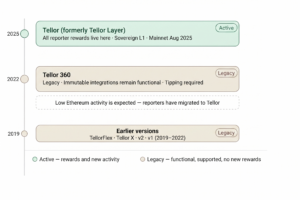
 Tellor has reached a pivotal milestone: reporter rewards have fully transitioned to Tellor Layer. If you’re a reporter still operating on legacy Tellor (Tellor 360) on Ethereum, this is your signal to migrate. From this point on, Tellor Layer will be referred to as simply, Tellor. We know this is an adjustment but moving forward when we say ‘Tellor’, we mean the Tellor Layer chain.
What Changed
Previously, Time-Based Rewards(TBR) were distributed through the legacy Ethereum-based system. With this transition complete, all reporter rewards are now issued directly on Tellor — the purpose-built, oracle blockchain that powers Tellor’s next-generation oracle infrastructure.
This means reporters are no longer dependent on legacy Tellor for their incentive loop. Reporting, validation, and compensation now live entirely within Layer’s consensus environment, reducing latency, cutting out bridging complexity, and aligning incentives more tightly with Tellor’s own security model.
Why This Milestone Matters
Reward distribution is central to any genuinely decentralized oracle network. Completing this transition onto Tellor means faster settlement within Tellor’s own block times, lower overhead with no Ethereum gas costs for reward claims, and tighter security alignment, validators and reporters are now economically grounded in the same chain they’re securing.
But what it means practically depends on who you are:
TRB holders
You can now participate in securing the network directly. By delegating your TRB to validators and reporters on Tellor, you become a Security Provider, earning rewards while strengthening the chain’s economic security. This is a new and meaningful role that didn’t exist in the legacy system.
Reporters
If you’re still staking on legacy Tellor on Ethereum, now is the time to migrate. The steps: unstake from legacy Tellor, bridge your TRB over to Tellor, then choose your role as Validator, Reporter, or Security Provider. Rewards are no longer issued on Ethereum. They live entirely on Tellor now, so staying on legacy means leaving incentives on the table.
Protocols and integrators
If your protocol was immutably deployed on legacy Tellor, your data feeds will continue to work, that won’t change. However, with Time-Based Rewards no longer available on Ethereum, tipping becomes the primary mechanism for incentivizing reporters on legacy Tellor. If your protocol depends on fresh, reliable data, you should plan for tipping to ensure reporters have a reason to serve your feeds. Legacy Tellor continues to operate; it just requires active demand signaling now rather than passive reward distribution.
Across all three groups, the common thread is the same: the protocol’s economic activity has a single home now, and it’s Tellor.
The Bigger Picture for Tellor
Tellor was built to serve as a sovereign oracle chain — one that can settle disputes, issue rewards, and govern itself without relying on any single L1 as a crutch. The rewards transition is one of the last major pieces needed to demonstrate that the chain can operate autonomously end-to-end.
This is meaningful for data consumers too. As more of the protocol’s critical paths move on-chain to Tellor, the trust surface becomes more auditable and verifiable. Developers integrating Tellor data can increasingly reason about the system’s behavior from first principles, without needing to track the state of multiple off-chain systems.
What’s Next
Upcoming milestones are focused on feedback received from the community, including improved timing for Reporter switching for Selectors, guardrails to prevent validators to accidentally grow over 30%, revisiting penalties and timeframes for validator jailing, expanding query support, deepening validator tooling, and continuing to grow the reporter set as Tellor’s economics become more compelling.
For anyone participating in the Tellor ecosystem — whether as a reporter, a TRB holder, or a protocol integrating oracle data — this is a good moment to pay attention. The system is converging, and the incentives are finally where they need to be.
Follow Tellor’s development on GitHub, stay up to date on X, & join the discussion on Discord.