
Oracles can introduce asymmetric information via systemic insider or selective disclosure. A risk seldom talked about. While asymmetric information in markets is normal (better analysts make more money), insider and selective disclosure are detrimental to investor confidence.
Up until August 2000, companies were allowed to disclose material nonpublic information(MNPI) to a select few, selective disclosure. These people were protected from insider trader charges as long as the person giving them the information did not benefit directly or indirectly. This protection was made explicit in 1983 after a Supreme Court ruling on Dirks vs SEC1 case that established the personal benefit test. The case was a whistleblowing case but it created a loophole and selective disclosure became very popular.
In August 2000 the SEC introduced a regulation for fair disclosure (Regulation FD) to combat this practice. This comes directly from the SEC Final rule on Selective disclosure and insider trading:
“Many issuers were disclosing important nonpublic information, such as advance warnings of earnings results, to securities analysts or selected institutional investors” before the general public and enabling those selected parties to “profit or avoid loss at the expense of those kept in the dark”. Regulation FD requires the issuer who discloses material nonpublic information to securities market professionals or security holders “to make public disclosure of that same information simultaneously (for intentional disclosures) or promptly (for non-intentionals disclosures)”.2
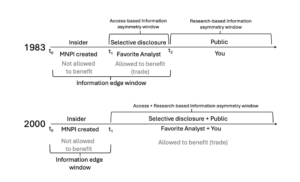
The problem here is that it created massive information asymmetry during the selective disclosure period. Although information asymmetry is always assumed and priced into markets (analysts, research firms, etc…) when it is systematically present via insider trading, selective disclosure or misappropriation it can have detrimental effects on the market as investor confidence erodes. Could crypto oracles have inadvertently recreated this problem?
Why is it bad
For this case, there are two types of information asymmetry, issuer-created via selective access (access-based information asymmetry) and research and analysis based (research-based information asymmetry). Research-based information asymmetry is priced into markets.
Market makers already operate under an adverse selection assumption and change their bid-ask spread depending on their confidence. Market makers use this to protect themselves from potentially selling before the price goes up or buying right before the price crashes. They sell for more and buy for less when the risk of trading against an insider or anyone with more or better information seems higher, therefore widening the bid-ask spread. Investor confidence erosion has a direct and quantifiable effect on the market and this risk premium is a social cost paid by everyone. When trust erodes, the spread widens, liquidity falls as individuals and institutions withdraw their funds and the investors left will require a higher return. At the threat of being cheated by insiders it’s normal to demand a risk premium but all of this leads to an increase in the cost of capital. According to Bhattacharya and Daouk (2002) in a study where they looked at developed and emerging market, the cost of capital dropped 6-7% once criminal insider trading laws were enforced3. That’s a high tax to pay so only a few can benefit.
Why it matters
In crypto, information goes through different stages and can also be exploited during windows of access-based information asymmetry. For example, an attacker exploited Levana4 protocol for 14 days back in December 2023. The attacker congested the chain and then placed trades before they allowed the oracle value to update. Being the source of the congestion, they were able to control the oracle updates, monitor when a big change was going to be reported and place trades to benefit from that change. They didn’t need to manipulate the asset, they just needed to know the oracle value and be able to act on it before others. They didn’t exactly create an information asymmetry window because other people could also see the information on the mempool but by managing the chain congestion they were able to keep others from taking any action or partake in the OEV(a synthetic access-based information asymmetry window). Putting aside the technicalities, this example highlights how knowing and being able to act on oracle information before others can be exploited similar to selective disclosure or insider trading. I will not be covering OEV here. Instead this is focused on highlighting the similarities of information asymmetry windows between traditional finance before 2000 and oracles and blockchain.
Before data makes it on-chain it goes through a three of stages:
Stage 1) Pre-mempool (data creation and relay), 2) Mempool and 3) on-chain
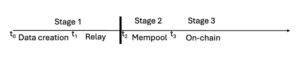
On stage 1, the data is being created and relayed. On stage 2, the transaction enters the mempool and OEV and MEV can happen. At this stage the information is public and value extraction depends on the technical capabilities of the extractor. On stage 3, the data has made it to on-chain storage and can be used. The window between stage 1 and stage 2 can be increasingly dangerous if a few actors know the value in advance and can act on that information before it hits stage 2. As crypto markets grow and institutional investors begin transacting on-chain this window becomes more important5. Crypto markets just like traditional markets will experience similar consequences as investor confidence erodes, such as liquidity drying up and ultimately leading to higher costs of capital.
There are two main oracle models for how consensus is reached on data, on-chain (or dapp chain) and off-chain. The difference between these two models as related to information asymmetry is the information edge window that exists in off-chain consensus but doesn’t on on-chain consensus. Depending on how the data is created off-chain, the access-based information asymmetry window can be expanded from when it’s being created to when it’s relayed. Up until this stage, the information is only available to a select few, creating the access-based asymmetry window (which is the window closed by Regulation FD) for them. The information finally becomes public at the mempool level when the relayer broadcasts the transaction with the oracle value. It is at that point that it becomes public and research-based information asymmetry can kick in, either in the form of MEV, OEV, or analysis based trading.
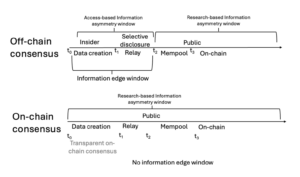 On the other hand, for on-chain consensus models, depending on how the oracle works, the data can be public from the data creation phase in stage 1. For example, Tellor is an L1 dapp chain and data is collected and aggregated on-chain to come to consensus on the official value for the query. The median of all the values collected for the query becomes the official value. The values being reported can be transparently observed by everyone, this removes the access-based information asymmetry window. Oracles using similar architecture only have a research-based information asymmetry window: this is similar to the structure Regulation FD achieved for tradfi investors and market makers. Once the chain reaches consensus on the official value, that can be relayed by anyone to the user’s chain, where it enters the mempool and eventually the chain storage.
The trade off for using off-chain consensus oracle is on the access-based information asymmetry window created by off-chain data creation. So it’s worth asking, if these are trusted roles, are they banned from trading on the information? How is this being monitored? The trade off for using on-chain consensus oracles is the expanded window for OEV or MEV. In this case one should ask, what is the effect of this window being larger? Does it make OEV and MEV more competitive? Are auctions for OEV more or less efficient? And ultimately, for both on and off-chain scenarios, is the increase in cost of capital created by the access-based asymmetry window worth the smaller OEV/MEV window? Why?
It is hard to win a bet against someone that is already aware of the outcome. Eventually people stop betting against them (i.e. giving them their money). Regulation FD attempted to level the playing field. Monitoring global markets for manipulation is not an easy task and we still need to improve that in crypto6. As with everything, there are trade-offs to each model. This is not financial advice.